|
Robot Framework
|


|
|
Robot Framework
|
|
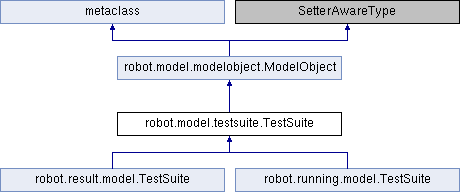
Base model for single suite. More...
Public Member Functions | |
| def | __init__ (self, name='', doc='', metadata=None, source=None, rpa=False, parent=None) |
| def | __str__ (self) |
| def | configure (self, **options) |
| A shortcut to configure a suite using one method call. More... | |
| def | filter (self, included_suites=None, included_tests=None, included_tags=None, excluded_tags=None) |
| Select test cases and remove others from this suite. More... | |
| def | metadata (self, metadata) |
| Free test suite metadata as a dictionary. More... | |
| def | remove_empty_suites (self, preserve_direct_children=False) |
| Removes all child suites not containing any tests, recursively. More... | |
| def | set_tags (self, add=None, remove=None, persist=False) |
| Add and/or remove specified tags to the tests in this suite. More... | |
| def | suites (self, suites) |
Child suites as a :class:~.TestSuites object. More... | |
| def | tests (self, tests) |
Tests as a :class:~.TestCases object. More... | |
| def | visit (self, visitor) |
:mod:Visitor interface <robot.model.visitor> entry-point. More... | |
 Public Member Functions inherited from robot.model.modelobject.ModelObject Public Member Functions inherited from robot.model.modelobject.ModelObject | |
| def | __repr__ (self) |
| def | config (self, **attributes) |
| Configure model object with given attributes. More... | |
| def | copy (self, **attributes) |
| Return shallow copy of this object. More... | |
| def | deepcopy (self, **attributes) |
| Return deep copy of this object. More... | |
Public Attributes | |
| doc | |
| metadata | |
| parent | |
| rpa | |
| source | |
| suites | |
| tests | |
Static Public Attributes | |
| fixture_class = Keyword | |
| tuple | repr_args = ('name',) |
| test_class = TestCase | |
| Static Public Attributes inherited from robot.model.modelobject.ModelObject | |
| tuple | repr_args = () |
Properties | |
| _visitors = property | |
| has_setup = property | |
| Check does a suite have a setup without creating a setup object. More... | |
| has_teardown = property | |
| Check does a suite have a teardown without creating a teardown object. More... | |
| has_tests = property | |
| id = property | |
| An automatically generated unique id. More... | |
| keywords = property | |
| Deprecated since Robot Framework 4.0. More... | |
| longname = property | |
| Suite name prefixed with the long name of the parent suite. More... | |
| name = property | |
| Test suite name. More... | |
| setup = property | |
Suite setup as a :class:~.model.keyword.Keyword object. More... | |
| teardown = property | |
Suite teardown as a :class:~.model.keyword.Keyword object. More... | |
| test_count = property | |
| Number of the tests in this suite, recursively. More... | |
Private Member Functions | |
| def | _visitors (self) |
| def | has_setup (self) |
| def | has_teardown (self) |
| def | has_tests (self) |
| def | id (self) |
| def | keywords (self) |
| def | keywords (self, keywords) |
| def | longname (self) |
| def | name (self) |
| def | name (self, name) |
| def | setup (self) |
| def | setup (self, setup) |
| def | teardown (self) |
| def | teardown (self, teardown) |
| def | test_count (self) |
Private Attributes | |
| _my_visitors | |
| _name | |
| _setup | |
| _teardown | |
Static Private Attributes | |
| list | __slots__ |
Base model for single suite.
Extended by :class:`robot.running.model.TestSuite` and
:class:`robot.result.model.TestSuite`.
Definition at line 34 of file testsuite.py.
| def robot.model.testsuite.TestSuite.__init__ | ( | self, | |
name = '', |
|||
doc = '', |
|||
metadata = None, |
|||
source = None, |
|||
rpa = False, |
|||
parent = None |
|||
| ) |
Definition at line 41 of file testsuite.py.
| def robot.model.testsuite.TestSuite.__str__ | ( | self | ) |
Definition at line 291 of file testsuite.py.
|
private |
Definition at line 58 of file testsuite.py.
| def robot.model.testsuite.TestSuite.configure | ( | self, | |
| ** | options | ||
| ) |
A shortcut to configure a suite using one method call.
    Can only be used with the root test suite.

    :param options: Passed to
        :class:`~robot.model.configurer.SuiteConfigurer` that will then
        set suite attributes, call :meth:`filter`, etc. as needed.

    Not to be confused with :meth:`config` method that suites, tests,
    and keywords have to make it possible to set multiple attributes in
    one call.
Reimplemented in robot.result.model.TestSuite.
Definition at line 276 of file testsuite.py.
| def robot.model.testsuite.TestSuite.filter | ( | self, | |
included_suites = None, |
|||
included_tests = None, |
|||
included_tags = None, |
|||
excluded_tags = None |
|||
| ) |
Select test cases and remove others from this suite.
    Parameters have the same semantics as ``--suite``, ``--test``,
    ``--include``, and ``--exclude`` command line options. All of them
    can be given as a list of strings, or when selecting only one, as
    a single string.

    Child suites that contain no tests after filtering are automatically
    removed.

    Example::

        suite.filter(included_tests=['Test 1', '* Example'],
                     included_tags='priority-1')
Definition at line 259 of file testsuite.py.
|
private |
Definition at line 147 of file testsuite.py.
|
private |
Definition at line 177 of file testsuite.py.
|
private |
Definition at line 224 of file testsuite.py.
|
private |
Definition at line 209 of file testsuite.py.
|
private |
Definition at line 187 of file testsuite.py.
|
private |
Definition at line 193 of file testsuite.py.
|
private |
Definition at line 78 of file testsuite.py.
| def robot.model.testsuite.TestSuite.metadata | ( | self, | |
| metadata | |||
| ) |
Free test suite metadata as a dictionary.
Definition at line 85 of file testsuite.py.
|
private |
Definition at line 66 of file testsuite.py.
|
private |
Definition at line 71 of file testsuite.py.
| def robot.model.testsuite.TestSuite.remove_empty_suites | ( | self, | |
preserve_direct_children = False |
|||
| ) |
Removes all child suites not containing any tests, recursively.
Definition at line 284 of file testsuite.py.
| def robot.model.testsuite.TestSuite.set_tags | ( | self, | |
add = None, |
|||
remove = None, |
|||
persist = False |
|||
| ) |
Add and/or remove specified tags to the tests in this suite.
    :param add: Tags to add as a list or, if adding only one,
        as a single string.
    :param remove: Tags to remove as a list or as a single string.
        Can be given as patterns where ``*`` and ``?`` work as wildcards.
    :param persist: Add/remove specified tags also to new tests added
        to this suite in the future.
Definition at line 238 of file testsuite.py.
|
private |
Definition at line 124 of file testsuite.py.
|
private |
Definition at line 131 of file testsuite.py.
| def robot.model.testsuite.TestSuite.suites | ( | self, | |
| suites | |||
| ) |
Child suites as a :class:~.TestSuites object.
Definition at line 90 of file testsuite.py.
|
private |
Definition at line 158 of file testsuite.py.
|
private |
Definition at line 165 of file testsuite.py.
|
private |
Definition at line 218 of file testsuite.py.
| def robot.model.testsuite.TestSuite.tests | ( | self, | |
| tests | |||
| ) |
Tests as a :class:~.TestCases object.
Definition at line 95 of file testsuite.py.
| def robot.model.testsuite.TestSuite.visit | ( | self, | |
| visitor | |||
| ) |
:mod:Visitor interface <robot.model.visitor> entry-point.
Definition at line 288 of file testsuite.py.
|
staticprivate |
Definition at line 38 of file testsuite.py.
|
private |
Definition at line 53 of file testsuite.py.
|
private |
Definition at line 43 of file testsuite.py.
|
private |
Definition at line 51 of file testsuite.py.
|
private |
Definition at line 52 of file testsuite.py.
| robot.model.testsuite.TestSuite.doc |
Definition at line 44 of file testsuite.py.
|
static |
Definition at line 36 of file testsuite.py.
| robot.model.testsuite.TestSuite.metadata |
Definition at line 45 of file testsuite.py.
| robot.model.testsuite.TestSuite.parent |
Definition at line 47 of file testsuite.py.
|
static |
Definition at line 37 of file testsuite.py.
| robot.model.testsuite.TestSuite.rpa |
Definition at line 48 of file testsuite.py.
| robot.model.testsuite.TestSuite.source |
Definition at line 46 of file testsuite.py.
| robot.model.testsuite.TestSuite.suites |
Definition at line 49 of file testsuite.py.
|
static |
Definition at line 35 of file testsuite.py.
| robot.model.testsuite.TestSuite.tests |
Definition at line 50 of file testsuite.py.
|
staticprivate |
Definition at line 56 of file testsuite.py.
|
static |
Check does a suite have a setup without creating a setup object.
    A difference between using ``if suite.has_setup:`` and ``if suite.setup:``
    is that accessing the :attr:`setup` attribute creates a :class:`Keyword`
    object representing the setup even when the suite actually does not have
    one. This typically does not matter, but with bigger suite structures
    containing a huge about of suites it can have some effect on memory usage.

    New in Robot Framework 5.0.
Definition at line 145 of file testsuite.py.
|
static |
Check does a suite have a teardown without creating a teardown object.
    See :attr:`has_setup` for more information.

    New in Robot Framework 5.0.
Definition at line 175 of file testsuite.py.
|
static |
Definition at line 222 of file testsuite.py.
|
static |
An automatically generated unique id.
    The root suite has id ``s1``, its child suites have ids ``s1-s1``,
    ``s1-s2``, ..., their child suites get ids ``s1-s1-s1``, ``s1-s1-s2``,
    ..., ``s1-s2-s1``, ..., and so on.

    The first test in a suite has an id like ``s1-t1``, the second has an
    id ``s1-t2``, and so on. Similarly keywords in suites (setup/teardown)
    and in tests get ids like ``s1-k1``, ``s1-t1-k1``, and ``s1-s4-t2-k5``.
Definition at line 207 of file testsuite.py.
|
static |
Deprecated since Robot Framework 4.0.
Use :attr:`setup` or :attr:`teardown` instead.
Definition at line 185 of file testsuite.py.
|
static |
Suite name prefixed with the long name of the parent suite.
Definition at line 76 of file testsuite.py.
|
static |
Test suite name.
If not set, constructed from child suite names.
Definition at line 64 of file testsuite.py.
|
static |
Suite setup as a :class:~.model.keyword.Keyword object.
    This attribute is a ``Keyword`` object also when a suite has no setup
    but in that case its truth value is ``False``.

    Setup can be modified by setting attributes directly::

        suite.setup.name = 'Example'
        suite.setup.args = ('First', 'Second')

    Alternatively the :meth:`config` method can be used to set multiple
    attributes in one call::

        suite.setup.config(name='Example', args=('First', 'Second'))

    The easiest way to reset the whole setup is setting it to ``None``.
    It will automatically recreate the underlying ``Keyword`` object::

        suite.setup = None

    New in Robot Framework 4.0. Earlier setup was accessed like
    ``suite.keywords.setup``.
Definition at line 122 of file testsuite.py.
|
static |
Suite teardown as a :class:~.model.keyword.Keyword object.
See :attr:`setup` for more information.
Definition at line 156 of file testsuite.py.
|
static |
Number of the tests in this suite, recursively.
Definition at line 216 of file testsuite.py.
 1.9.1
1.9.1