|
| def | __init__ (self, name='', doc='', metadata=None, source=None, rpa=False) |
| |
| def | configure (self, randomize_suites=False, randomize_tests=False, randomize_seed=None, **options) |
| | A shortcut to configure a suite using one method call. More...
|
| |
| def | randomize (self, suites=True, tests=True, seed=None) |
| | Randomizes the order of suites and/or tests, recursively. More...
|
| |
| def | run (self, settings=None, **options) |
| | Executes the suite based based the given settings or options. More...
|
| |
| def | configure (self, **options) |
| | A shortcut to configure a suite using one method call. More...
|
| |
| def | filter (self, included_suites=None, included_tests=None, included_tags=None, excluded_tags=None) |
| | Select test cases and remove others from this suite. More...
|
| |
| def | keywords (self, keywords) |
| | Suite setup and teardown as a :class:~.Keywords object. More...
|
| |
| def | metadata (self, metadata) |
| | Free test suite metadata as a dictionary. More...
|
| |
| def | remove_empty_suites (self) |
| | Removes all child suites not containing any tests, recursively. More...
|
| |
| def | set_tags (self, add=None, remove=None, persist=False) |
| | Add and/or remove specified tags to the tests in this suite. More...
|
| |
| def | suites (self, suites) |
| | Child suites as a :class:~.TestSuites object. More...
|
| |
| def | tests (self, tests) |
| | Tests as a :class:~.TestCases object. More...
|
| |
| def | visit (self, visitor) |
| | :mod:Visitor interface <robot.model.visitor> entry-point. More...
|
| |
| def | __repr__ (self) |
| |
| def | __setstate__ (self, state) |
| | Customize attribute updating when using the copy module. More...
|
| |
| def | __unicode__ (self) |
| |
| def | copy (self, **attributes) |
| | Return shallow copy of this object. More...
|
| |
| def | deepcopy (self, **attributes) |
| | Return deep copy of this object. More...
|
| |
Represents a single executable test suite.
See the base class for documentation of attributes not documented here.
Definition at line 117 of file model.py.
| def robotide.lib.robot.running.model.TestSuite.configure |
( |
|
self, |
|
|
|
randomize_suites = False, |
|
|
|
randomize_tests = False, |
|
|
|
randomize_seed = None, |
|
|
** |
options |
|
) |
| |
A shortcut to configure a suite using one method call.
    Can only be used with the root test suite.

    :param randomize_xxx: Passed to :meth:`randomize`.
    :param options: Passed to
        :class:`~robot.model.configurer.SuiteConfigurer` that will then
        set suite attributes, call :meth:`filter`, etc. as needed.

    Example::

        suite.configure(included_tags=['smoke'],
                        doc='Smoke test results.')
Definition at line 143 of file model.py.
| def robotide.lib.robot.running.model.TestSuite.randomize |
( |
|
self, |
|
|
|
suites = True, |
|
|
|
tests = True, |
|
|
|
seed = None |
|
) |
| |
Randomizes the order of suites and/or tests, recursively.
    :param suites: Boolean controlling should suites be randomized.
    :param tests: Boolean controlling should tests be randomized.
    :param seed: Random seed. Can be given if previous random order needs
        to be re-created. Seed value is always shown in logs and reports.
Definition at line 155 of file model.py.
| def robotide.lib.robot.running.model.TestSuite.run |
( |
|
self, |
|
|
|
settings = None, |
|
|
** |
options |
|
) |
| |
Executes the suite based based the given settings or options.
    :param settings: :class:`~robot.conf.settings.RobotSettings` object
        to configure test execution.
    :param options: Used to construct new
        :class:`~robot.conf.settings.RobotSettings` object if ``settings``
        are not given.
    :return: :class:`~robot.result.executionresult.Result` object with
        information about executed suites and tests.

    If ``options`` are used, their names are the same as long command line
    options except without hyphens. Some options are ignored (see below),
    but otherwise they have the same semantics as on the command line.
    Options that can be given on the command line multiple times can be
    passed as lists like ``variable=['VAR1:value1', 'VAR2:value2']``.
    If such an option is used only once, it can be given also as a single
    string like ``variable='VAR:value'``.

    Additionally listener option allows passing object directly instead of
    listener name, e.g. ``run('tests.robot', listener=Listener())``.

    To capture stdout and/or stderr streams, pass open file objects in as
    special keyword arguments ``stdout`` and ``stderr``, respectively.

    Only options related to the actual test execution have an effect.
    For example, options related to selecting or modifying test cases or
    suites (e.g. ``--include``, ``--name``, ``--prerunmodifier``) or
    creating logs and reports are silently ignored. The output XML
    generated as part of the execution can be configured, though. This
    includes disabling it with ``output=None``.

    Example::

        stdout = StringIO()
        result = suite.run(variable='EXAMPLE:value',
                           critical='regression',
                           output='example.xml',
                           exitonfailure=True,
                           stdout=stdout)
        print result.return_code

    To save memory, the returned
    :class:`~robot.result.executionresult.Result` object does not
    have any information about the executed keywords. If that information
    is needed, the created output XML file needs to be read  using the
    :class:`~robot.result.resultbuilder.ExecutionResult` factory method.

    See the :mod:`package level <robot.running>` documentation for
    more examples, including how to construct executable test suites and
    how to create logs and reports based on the execution results.

    See the :func:`robot.run <robot.run.run>` function for a higher-level
    API for executing tests in files or directories.
Definition at line 212 of file model.py.


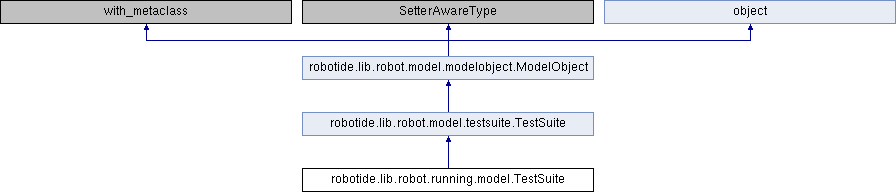
 Public Member Functions inherited from robotide.lib.robot.model.testsuite.TestSuite
 1.9.1
1.9.1